Your cart
There are no more items in your cart

The best dog beds in 2026: how to pick the right one for your dog's size
Posted on2026-05-13
by

If you've ever bought a bed for your dog and watched it sit unused in a corner two weeks later while they head back to your sofa, you know what I mean. At Mascoboutique, every single week someone walks in who has already tried two or three different beds for their dog and still hasn't got it right. And it's not their fault: dog beds are one of the products people get most confused about, because they all look the same — but they really aren't. Let's get to it.
Why the bed you choose for your dog matters
An adult dog sleeps between twelve and fourteen hours a day. Puppies and senior dogs even more. The bed is, no exaggeration, the piece of furniture your dog uses most in the whole house — more than the food bowl, more than your sofa, more than their lead. And yet, it's the last thing people put any thought into choosing.
A badly chosen bed isn't just a wasted purchase tucked into a corner. It's a dog that sleeps badly, gets up stiff in the morning, doesn't recover properly after a walk, or ends up sleeping on the floor or on your sofa because theirs just doesn't do the job. Senior dogs and breeds prone to joint problems — dachshunds, French bulldogs, large dogs in general — are the ones who suffer most with a dog bed that doesn't support them.
What I see in the shop every week is always the same: people buy on looks or price, then come back to swap it because "they don't use it". A good dog bed has to do three things. Hold the dog's weight without sagging. Be easy to wash. And be the right size. The colour and the decor come second.
Bed types: which one fits which dog
Not every bed works for every dog. These are the three main families — what each one does and who I recommend it for when someone comes into the shop asking for advice.
Cushion beds and dog mats
The cushion bed is the simplest one: a padded base, flat or with very low edges, no raised structure. The dog mat is the flattest, thinnest version, perfect for stretching out. They're ideal for young, active dogs who sleep stretched out, for popping in the car, or as a secondary bed in the kitchen, the living room or your study.
I recommend them when the dog is young, has no joint problems, likes to sleep stretched out and you need something easy to move around the house. They're also a good option for summer, because being flat they keep less heat than beds with high sides.
Raised or sofa-style beds
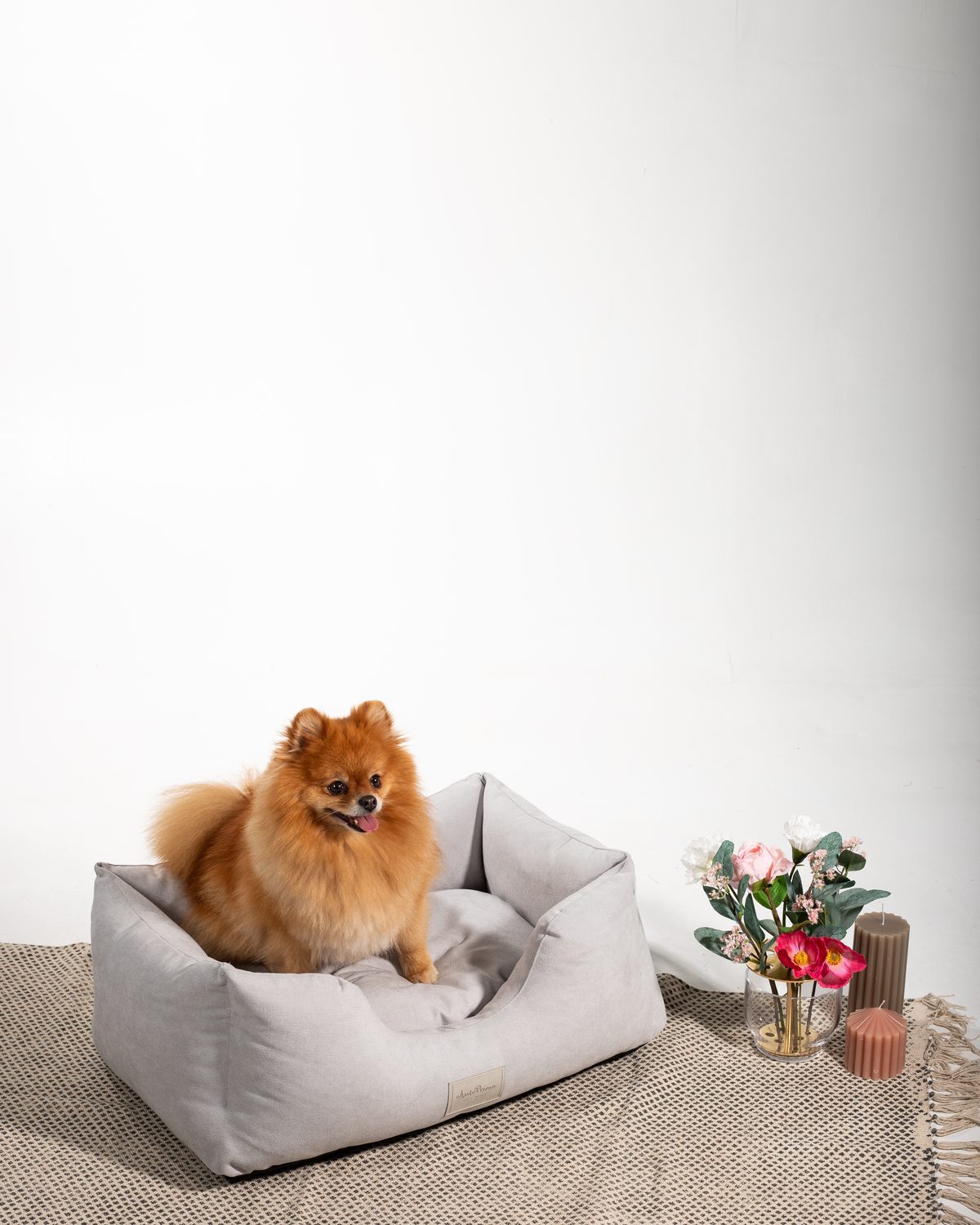
This is where we get into "proper" bed territory. They have a structured base with high sides on three edges — a bit like a small sofa — and a cushion inside. The dog has somewhere to rest their head, gets that den-like feeling and, importantly, sits a bit off the floor, which matters when it's cold or you have tile floors.
I recommend them when the dog likes to curl up, likes resting their head when sleeping, your floor gets cold in winter or the dog is starting to feel its age. For small and medium dogs they're my default recommendation. For larger dogs they also work very well, as long as the structure can take the weight without sagging.
Anti-stress (donut) beds
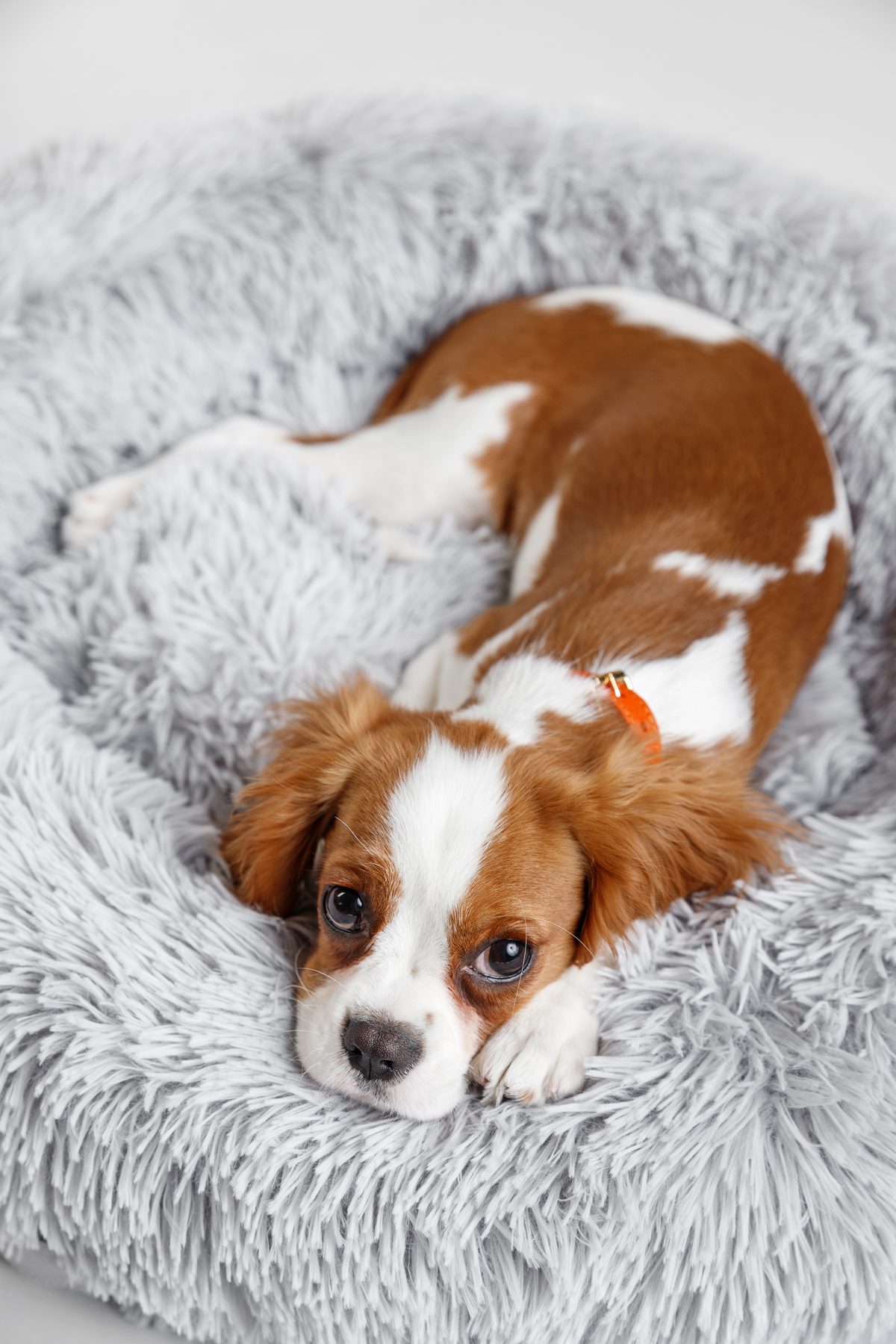
The anti-stress dog bed is that round, donut-shaped format with very high, padded edges that wrap right around the dog. The idea is simple: the dog finds somewhere to rest their head whichever way it lies, feels protected and relaxes. It's not magic or advanced canine psychology — it's the same thing that happens to us when we sleep hugging a pillow.
I recommend them when the dog is nervous, struggles with loud noises (thunderstorms, fireworks, moving days, building work on the street), sleeps best curled into a ball or simply likes resting their head as they sleep. They usually have a fluffy, lamb-look finish that adds extra warmth in winter and looks beautiful in any corner of the home. They cover the needs of most small dogs and many medium ones very nicely.
How to pick the right size: the rule we use in the shop
This is the mistake I correct most often in the shop. People buy a bed "the size of the dog", not the size the dog actually needs to sleep well.
The rule we use at Mascoboutique is simple: measure your dog lying on their side, from the tip of the nose to the base of the tail (don't count the tail). Add between ten and fifteen centimetres to that number. That's the minimum usable inner length of the bed.
Why add to it? Because dogs don't always sleep curled up. They stretch, they roll over, they rest their head outside the cushion. If the bed is too tight, the moment they shift they tumble out. And then they go back to the floor. Or to your sofa.
For dogs that often sleep in the "sphinx" position — head resting, paws stretched out — go up a size. For dogs that always sleep curled in a ball, a tighter fit is fine. honest tip: if you're choosing between two sizes, always go for the bigger one. I see far more beds returned for being too small than for being too big.
The most common mistakes when buying a dog bed
These are the ones I see repeating every week in the shop:
- Buying on looks before use. If the bed isn't fully removable and machine-washable, it doesn't matter how pretty it is: three months in, it smells of dog and there's no rescuing it. The cover has to come off, go in the washing machine, and the bed itself has to last.
- Picking a smaller size "so they curl up". Dogs don't curl up for fun: if the bed is too small, they have no choice. Give them the room and they'll choose how they want to sleep.
- Buying a hollow-fibre bed for a senior dog. Beds filled with loose pellets or bobble stuffing flatten within weeks. If the dog is older or heavy, that bed won't do the job, however soft it feels at first. They need a bed with structure that holds its shape.
- Ignoring the base. A bed without a non-slip base slides all around the living room every time the dog jumps in and out. Seems like a small thing — until you've spent three months pushing it back into place every night.
- Assuming one bed is enough. In summer many dogs prefer a flat mat or cool tiles. In winter, a sofa-style bed with high sides. Two beds at home — one of each — tends to be more useful than putting the whole budget into one.
Our pick of dog beds at Mascoboutique
Whenever someone comes into the shop looking for a bed, these are the options I put on the counter. They aren't the only ones we stock, but they're the ones I recommend most because they cover almost every case — from the puppy to the senior dog.
- Cama Vicky. This is our everyday bed for small and medium dogs. 70% cotton, 30% synthetic fabric, fully removable, with a gingham print that looks great in any living room. It's light, easy to move and very easy to wash. I recommend it when you want a bed that's pretty, practical and reasonably priced for a young or adult dog with no joint problems. It comes both as a sofa-style bed (with sides) and as a flat mat to match — ideal for combining different rooms.
- Cama Capri Soro. From the Italian brand Ante Prima. Jacquard fabric and three fully removable pieces — one of the easiest beds to keep clean in the whole catalogue. Plump cushion and high sides that give that den feeling. I recommend it for small and medium dogs that spend a lot of time on their bed, and for homes where the bed is on display, because it's genuinely beautiful.
- Cama Argo Soro. Also from Ante Prima, fully designed and made in Italy. This is the "premium" bed in our catalogue and the one I recommend for medium dogs, large dogs and senior dogs. It has a proper structure (it doesn't lose its shape with use), two removable cushions with zips, a non-slip synthetic-leather base and a lowered front edge so dogs with limited mobility can get in and out without a struggle. The fabric is hypoallergenic, water-repellent and scratch-resistant. Available in S, M and L. If you have a large dog or a senior dog who needs a firm, long-lasting bed, this is the one that will suit them best.
- Cama Loppa. From Hunter. This is our go-to anti-stress bed: round, with high padded edges and a fluffy finish that's irresistible to dogs that look for shelter. If your dog always sleeps curled into a ball, gets startled by noises or finds it hard to relax, this is the one I recommend most. It also works very well as a secondary bed — that corner of the living room where they curl up while you're working — and it looks gorgeous in any setting.
If you're torn between two models, you can take a look at our full selection of dog beds for small dogs and dog beds for large dogs, or message us on WhatsApp with the breed and age of your dog and we'll tell you which fits best. That's what we're here for.
In short: how to choose the perfect dog bed
If you want to get the bed right and not end up buying three:
- Measure your dog lying down and add ten to fifteen centimetres. That's the minimum size.
- If the dog is older, a large breed or heavy, go straight for a bed with a firm structure that doesn't sag. You'll save yourself time — and them, bad nights.
- If your dog is nervous, easily startled or loves sleeping curled in a ball, a donut-style anti-stress dog bed will become their favourite spot in the house.
- The cover has to come off and go in the washing machine. If not, don't buy it.
- It has to have a non-slip base or some way of staying put on the floor.
- If you're torn between two sizes, go for the bigger one.
And if you still aren't sure, message us or drop by the shop and we'll help you pick the dog bed your dog actually needs. Better to get it right once than wrong three times.
About the author
Mar is the founder of Mascoboutique. What began as an idea to dress and equip her own dog grew, over the years, into a reference boutique in Madrid for families with dogs. Every bed, harness or lead that comes into the shop passes through her hands first: she tests the materials, looks at the stitching and pictures the dog who'll end up using it. That old-school shop expert's eye is what she also applies to the blog: here we don't recommend what sells best, we recommend what she would put on her own dog.