Your cart
There are no more items in your cart

No-pull dog harness guide: which to choose and how to use it well
Posted on2026-05-20
by

If your dog pulls on the lead until it chokes, you’ll already have heard of the no-pull harness. And you’ve probably also wondered: does it really work or is it another gimmick? I’ll tell you the same thing I tell whoever comes into the shop dragged in by their dog: the no-pull harness works, but it isn’t magic. It’s pure physics. Let’s take a look.
What is a no-pull harness and how does it work?
A normal harness clips the lead to a ring on the dog’s back. The no-pull one adds (or moves) a second ring to the chest, at the front. That’s the whole secret. That’s why it’s also called a front-clip harness.
When the lead is clipped to the back and the dog pulls, its whole body pushes forward in a straight line —like a sled—. It’s the position in which a dog pulls hardest, because it works with its own anatomy. By contrast, when the lead is clipped to the chest and the dog pulls, the tension gently turns it to one side, towards you. It can’t launch in a straight line because every time it tries, its own momentum redirects it. It doesn’t hurt it, it doesn’t punish it: it simply takes away the physical leverage it needs to drag you. That’s what I mean by pure physics.
The no-pull harness doesn’t “train” the dog on its own. What it does is put you in a position of advantage so you can work on the walk without the dog choking or dislocating your shoulder. It’s a transition and management tool, not a magic wand.
Which dogs does it suit and which not?
Here’s where I want to be honest, because it’s the part no salesperson tells you. The no-pull harness doesn’t suit every dog equally.
It does help, a lot, in these cases:
- Dogs that pull out of enthusiasm, not anxiety: the typical happy dog that wants to get to the park sooner. For that one, the change is immediate.
- Medium and large dogs that already have enough strength to drag you. Here the no-pull harness is almost a safety matter for your back.
- Owners who are starting to work on loose-lead walking and need a tool that doesn’t hurt while the dog learns.
And I’ll be sincere: there are cases where it does little or nothing. A no-pull harness isn’t the magic solution if your dog pulls out of anxiety or fear —there the problem is emotional and has to be worked on with a trainer, not with gear—. Nor does it work miracles on very small dogs that barely weigh anything: a no-pull harness for a small dog makes sense for the comfort and chest support, but a three-kilo yorkie isn’t going to drag you, so don’t expect a spectacular anti-pull effect from it. And, above all, it doesn’t replace training: if you put it on and still don’t work on anything, the dog improves a bit, but it doesn’t “stop pulling” forever.
How to use it correctly: the mistakes that cancel its effect
I see this every week in the shop: someone buys a no-pull harness, uses it wrong and then tells me it “doesn’t work”. It’s almost always one of these slip-ups. Knowing how to use a no-pull harness well makes all the difference.
- Clipping the lead to the back ring instead of the chest one. It’s mistake number one. If you use the back ring, you have a normal harness and the no-pull effect disappears. The lead goes on the front ring, the chest one.
- Leaving it too loose. If the harness wobbles, the front ring shifts and stops redirecting properly. It has to be snug —two fingers between the strap and the body, no more, no less—.
- Using a lead that’s too long or extendable. The no-pull harness works with a fixed-length lead and close control. With an extendable one, the dog builds up speed and the effect is lost. To work on pulling, a fixed lead of one to one and a half metres.
- Expecting results without backing it up with treats. The no-pull harness gives you physical control, but the dog learns faster if you reward it when it walks beside you on a loose lead. Carry treats the first month.
- Putting it on inside out or with twisted straps. The front ring has to sit centred on the chest, at the level of the breastbone. If it sits crooked, it doesn’t distribute the tension well.
No-pull harness vs training collar: key differences
A lot of people ask me about training collars —the punishment ones, the prong ones, the shock ones—. My stance in the shop is clear and I don’t hide it: I don’t sell them and I don’t recommend them. And here’s the underlying difference.
A punishment-type training collar works by generating pain or discomfort when the dog pulls. The dog stops pulling to avoid the harm. It can work fast, yes, but at the cost of associating the walk with fear, and that in the medium term creates behavioural problems worse than the original pulling.
The no-pull harness works the other way round: it doesn’t punish, it redirects. The dog doesn’t stop pulling out of fear of pain, but because physically it can’t move forward by pulling. And meanwhile, you reward what you do want. It’s slower than punishment, but it builds confidence instead of fear. For me there’s no contest.
Our pick of no-pull harnesses at Mascoboutique
In the shop I don’t have twenty different no-pull harnesses, I have the one I genuinely recommend. I’d rather have one good model than a counter full of mediocre options.
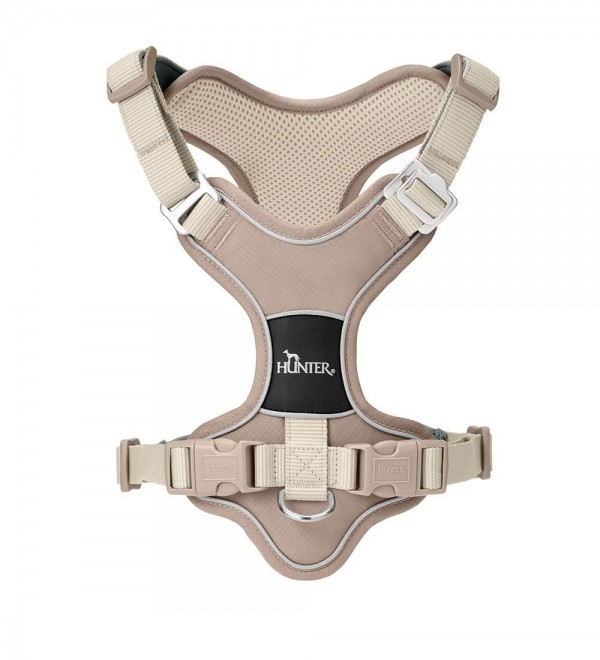
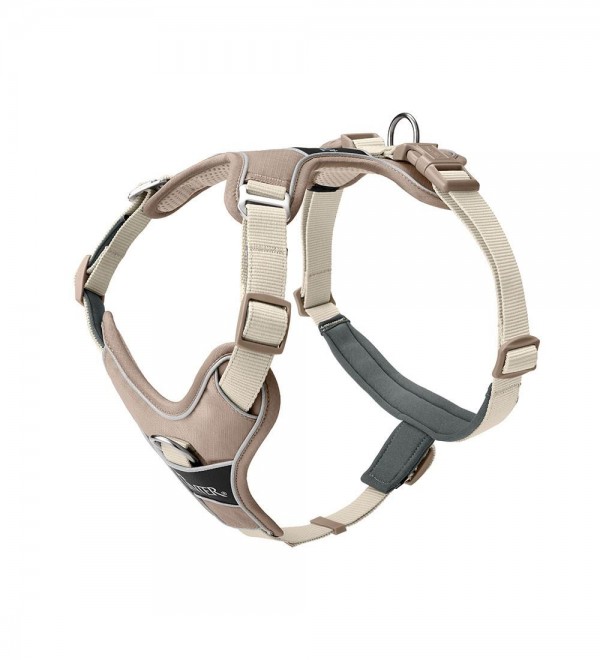
- Divo-Up harness by Hunter. It’s our reference in no-pull harnesses, and it’s no accident. It has the front ring on the chest that does all the work —the physics I was telling you about—, it’s very well padded so it doesn’t rub even if the dog pulls, and it adjusts to the millimetre with regulators on both the neck and the chest, so it really adapts to each dog’s shape. The fastening is a click buckle, quick to put on and take off. I recommend it for medium and large dogs that pull out of enthusiasm, and also for slightly stubborn small dogs where you want to add the no-pull effect to the comfort. German brand, Hunter quality of the kind that lasts for years.
You can see it in our dog harness section, where you’ll also find H-harnesses and other models if what you’re after isn’t exactly a no-pull one. And if you’re torn between one and another, I recommend reading our complete guide on how to choose a harness for a small dog, where I explain type by type. If you still aren’t sure, message us on WhatsApp with your dog’s breed and weight and we’ll tell you which suits best.
In short: when it’s worth it and when it isn’t
So you take away what matters:
- The no-pull harness works because it redirects the dog with the front chest ring. It’s physics, not punishment, not magic.
- It’s very much worth it if your dog pulls out of enthusiasm, if it’s medium or large, or if you’re starting to work on the walk. It’s the most honest solution for a dog that pulls on the lead.
- It does little if the dog pulls out of anxiety or fear (that’s a trainer’s job) or if it’s so small it can’t drag you.
- Always clip the lead to the chest ring, fit it well, use a fixed lead and back it up with treats the first month.
- It isn’t a substitute for training: it’s the tool that gives you control while the dog learns.
A good no-pull harness, well used, changes your walk within a week. Used badly, it does nothing. Now you know which side the difference is on. And if you’d like us to help you choose, here we are.
About the author
Mar is the founder of Mascoboutique. What began as an idea to dress and equip her own dog grew, over the years, into a reference boutique in Madrid for families with dogs. Every harness, lead or collar that comes into the shop passes through her hands first: she tests the materials, looks at the stitching and pictures the dog that will wear it. That old-school shop expert’s eye is what she also applies to the blog: here we don’t recommend what sells best, we recommend what she would put on her own dog.