Your cart
There are no more items in your cart

How to choose a small dog harness: the complete 2026 guide
Posted on2026-05-06
by

If you have a small dog, you've probably already asked yourself this: collar or harness? And if a harness, which one? At Mascoboutique I've spent years recommending harnesses to clients who walk in with a three-kilo Yorkie, a Maltese puppy or an adult dachshund, and the answer is never the same. That's why I wanted to sit down and write this guide: so when you go to buy a small dog harness in 2026, you choose it with criteria and not based on the first pretty photo you see online.
In the lines that follow I'll tell you why a good harness is far more important than it might seem, what types exist (with their real differences, not the marketing ones), how to measure your dog step by step, the mistakes I see every week in the shop and our harness picks at Mascoboutique so you have concrete references. Here we go.
Why a harness matters for a small dog
A small dog has a narrower trachea and more delicate cervical vertebrae than a large dog. That means a collar, the moment the dog pulls a little hard or you give a sharp tug to correct him, can cause injuries that don't show up on day one but appear later: dry cough, tracheal collapse, neck problems. I've seen clients come in worried because their six-year-old Yorkie has started coughing when drinking water, and when we ask, we discover the dog has spent his whole life walking with a collar and pulling.
A harness spreads the tension across the chest and ribs, areas far better equipped to bear force. On top of that, in mini breeds — Chihuahua, Pomeranian, Maltese, Yorkshire — the neck is so thin that a collar can slip up over the head with frightening ease and leave the dog loose in a second of distraction. With a properly fitted harness that doesn't happen.
There's also one thing we tend to forget: the harness is also a communication tool. You feel better what your dog is doing, and the dog feels better what you're asking. If you've always walked with a collar and switch to a good harness, you'll notice it from day one.
Types of harnesses: which is best for your dog?
There's no universal "ideal" harness. There are harnesses that work depending on the dog, his age, his temperament and the kind of walks you do together. These are the three types I recommend most often in the shop, and which case each one suits.
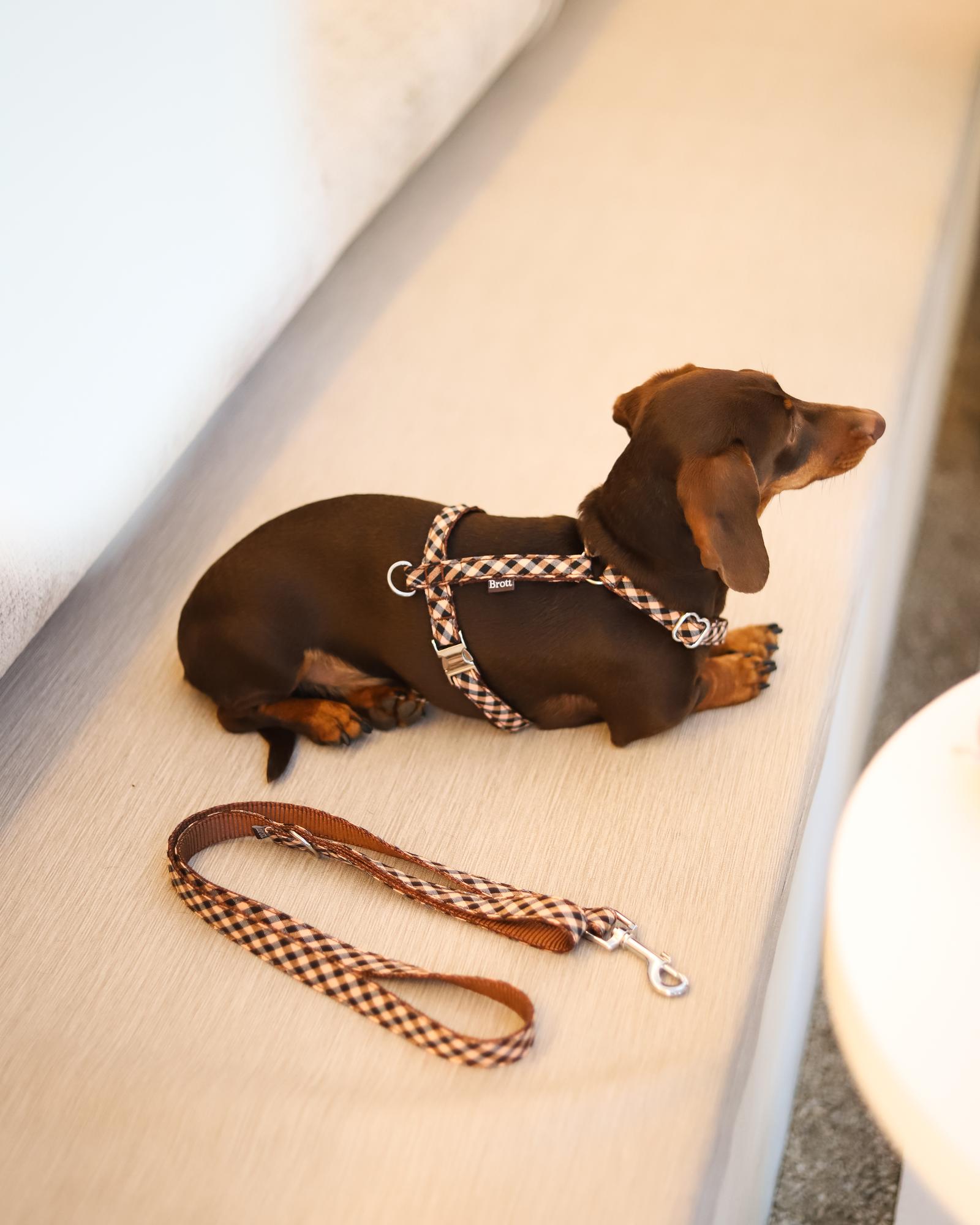
Step-in harness (adjustable or vest type)
This is the most typical harness for small breeds and, especially, for puppies. It's called step-in because the main piece passes across the dog's chest in a Y or wide-strap shape. The good thing about this kind is that you put it on by stepping the front paws in and fastening it on top of the back with Velcro, a buckle or a click clasp. It's quick, simple and usually comfortable.
Within step-in there are two very useful variants. The adjustable version lets you keep opening up the harness as the puppy grows — and trust me, a puppy's body changes month to month; instead of buying three harnesses in six months, you adjust the same one. The vest version has a larger contact area, is usually padded and spreads pressure even better; it's ideal for dogs with sensitive skin or for winter, since it adds a touch of warmth. If you're after a small dog harness for a puppy that you don't have to replace every two months, the adjustable step-in is your most sensible option.
I recommend it when: you have a puppy, a very small breed that already walks calmly, or you want something comfortable for short everyday walks.
H-style harness
The H-style harness has its leash ring sitting a bit further back, over the lower back, instead of right between the shoulder blades. Seen from above the straps form an H — hence the name. You put it on by slipping the head through the front and fastening behind, on the back. Most are adjustable in three or four points, which lets you tailor the fit to your dog's exact shape.
Why does it matter that the ring sits further back? Because when you pull on the lead, the force doesn't fall on the neck or the upper chest, but on the mid-to-lower dorsal area, which is far more resistant. That makes it especially recommended for breeds with sensitive backs (dachshund, corgi, basset) and for adult dogs who already walk with some manners and don't need re-education.
I recommend it when: your small dog is already an adult and walks without pulling like crazy, or when it's a long-bodied breed that needs the tension well distributed.
No-pull harness
The no-pull harness is, in fact, a variant of the H-style, but with one key detail: it has an extra ring at the front, on the chest. So why does that change so much? Because when you clip the lead to that front ring and the dog pulls forward, his own body is forced to turn gently towards you. It's pure physics. The dog can't sustain the pull because every time he pulls, his body redirects.
It's not a punishment or a force tool — important. It's a learning tool. The idea is for the dog to discover for himself that pulling stops being effective. You combine it with a good lead, positive reinforcement and patience, and in a few weeks you'll see real changes.
I recommend it when: your small dog pulls a lot, is in the middle of lead training, or you've adopted an adult dog who comes "untrained". It also works really well on puppies who started off marching ahead.
How to measure your dog for a harness
This is the part where most mistakes happen. The wrong size turns the best harness in the world into an uncomfortable nuisance. You'll need a soft sewing tape measure and, if possible, another person to keep the dog calm.
The most important measurement is the chest girth. Pass the tape just behind the front legs, around the thorax, at the widest point. The tape should sit firm but not tight: you should be able to fit two fingers underneath.
With that measurement in hand, open the brand's specific size chart. And here's an honest tip: sizes aren't universal. A Milk and Pepper "S" isn't exactly the same as a Hunter "S". Always look at the brand's specific chart, and if your dog falls right between two sizes, go up to the larger one — provided the harness is adjustable. It's easier to take it in than to let it out.
If your dog is a puppy, bear in mind he's going to grow. Ask your vet what adult weight is estimated for the breed, or ask your breeder how much your puppy's parents weighed. Buy a size with room to grow into. That's why I'm so insistent on adjustable harnesses for puppies: you make the most of the purchase and save your dog three full kit changes in his first year.
The most common mistakes when fitting a harness
After many years working in the shop, the mistakes I see repeat themselves over and over. Let me tell you so you avoid them from day one.
Fitting it too tight or too loose. The two-finger rule is your friend: if two flat fingers fit between the harness and the dog, it's well fitted. If only one fits, tighten it. If three or more fit, it's loose and the dog can escape.
Confusing collar and harness. The collar is still necessary for the ID tag, the visible microchip and, in many regions, by law. But the lead goes on the harness, not the collar. I correct this several times a month in the shop.
Not checking the harness regularly. Stitches wear, buckles loosen, Velcro loses grip. Especially if your dog is a swimmer, plays a lot in mud or you use the same harness daily, check it every two or three months.
Always buying the cheapest one. A poor-quality harness breaks, chafes, bleeds dye onto light coats and, in the worst case, lets the dog loose in the middle of a crossing. You don't need to spend a fortune, but investing in a well-made harness is investing in safety. It lasts you years.
Storing it in a knot. If you leave it bundled up in a drawer, the straps deform and the padding loses shape. Hang it flat or roll it up carefully.
Our harness picks at Mascoboutique
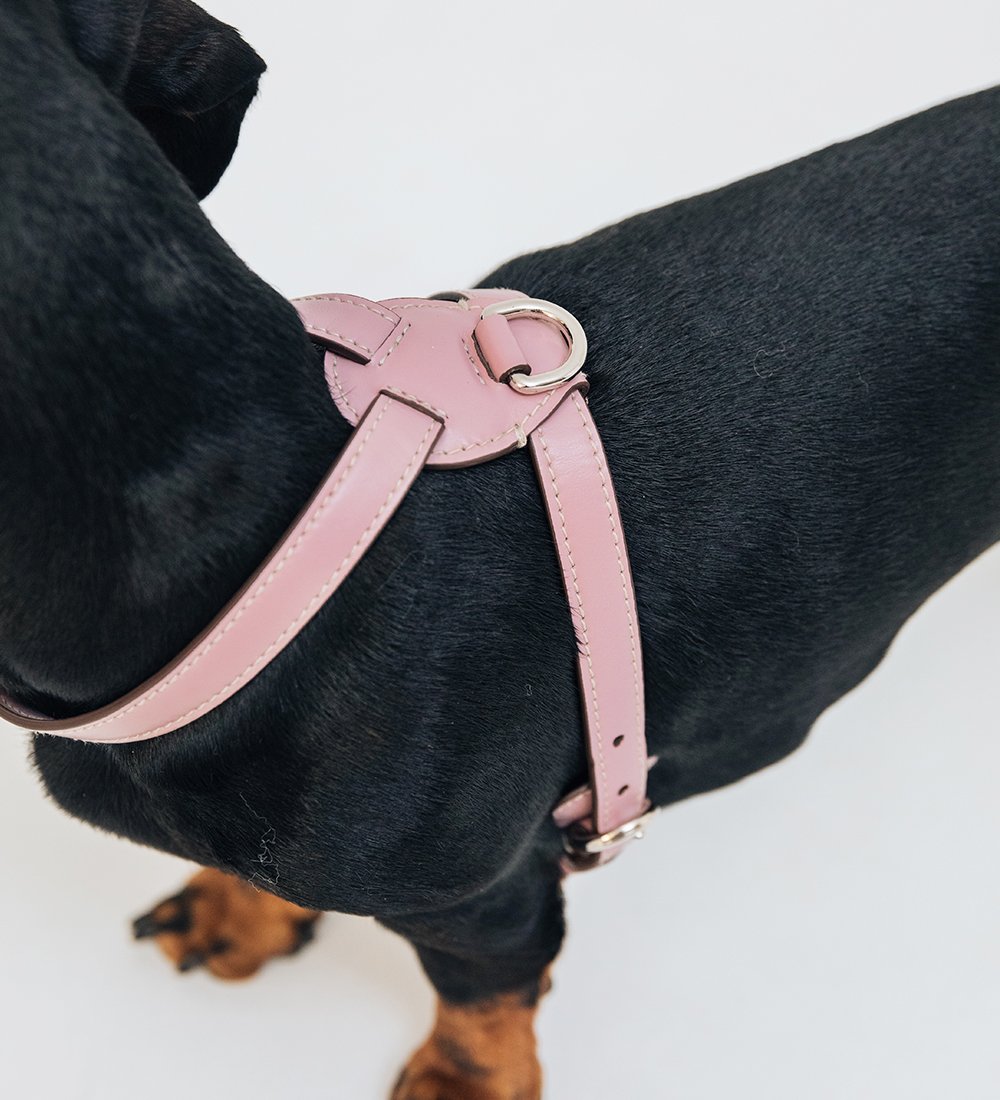
For concrete references, these are the models we sell most and that I myself recommend depending on the dog's profile. When a client walks in asking for a "small dog harness", these are the options I lay on the counter.
If you're after an adjustable or vest-type step-in harness:
- Brott Maians harness. Adjustable step-in in technical fabric, very light, with reinforced stitching. Perfect for mini breeds that already walk calmly and for growing puppies.
- Beige leather harness by Perro Collection. Step-in in genuine leather, artisanal Italian finish. For clients looking for something elegant and durable, who don't want plastic and will look after it.
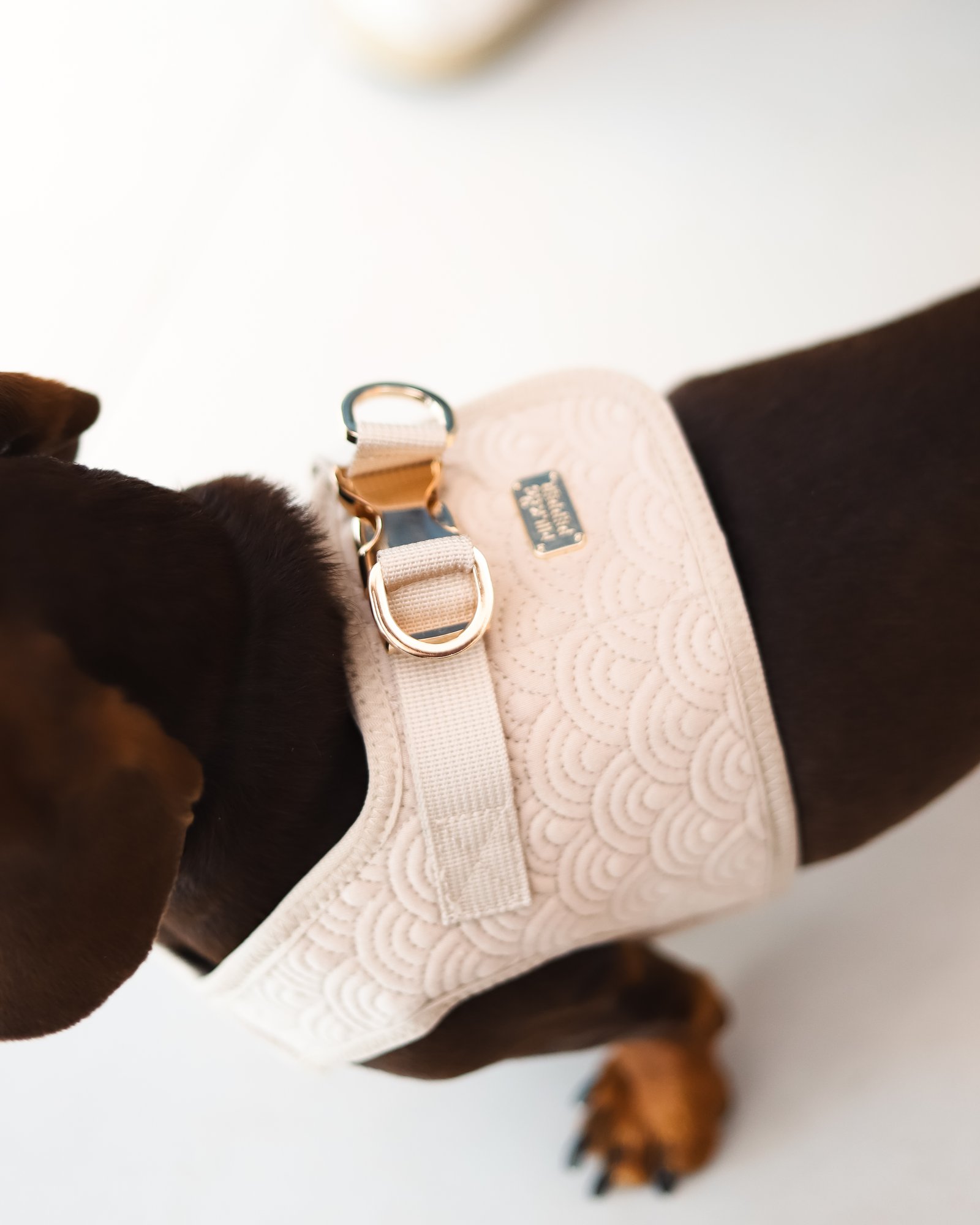
- Fuyi taupe harness by Milk and Pepper. Vest version, quilted with a curved scallop pattern in relief, double leash ring and gold-tone hardware. One of the prettiest in our catalogue: texture, feel and a touch of warmth. I especially recommend it for winter or short-coated dogs that get cold on long walks.
If you're after an H-style harness:
- Brott Montserrat H-harness. Adjustable in several points, with a brown-and-cream gingham print, silver hardware and an extra ring on the back. Tough materials and a pattern that goes with almost everything. It's our everyday all-rounder, and looks especially lovely on dachshunds and dark-coated mini breeds.
- Kaya cream H-harness by Milk and Pepper. H-style with a beautifully thought-out design and quality fabrics. A very recognisable look and the brand's signature comfort.
- Nuvola olive leather harness by Carlotta Palermo. The most premium of the three H-style options. Italian leather in olive, refined buckle and lines so clean it looks more like a fashion accessory than a harness. For clients who care about every detail of the walk and want kit that ages beautifully.
If your dog pulls and you need a no-pull:
- Divo-Up no-pull harness by Hunter. Our reference for no-pull harnesses. The front ring on the chest does all the work, it's well padded and adjusts to the millimetre. It's the one I recommend to every client who walks in saying "he just pulls so much".
You'll see we mix exclusive brands like Milk and Pepper, Brott, Perro Collection, Carlotta Palermo and Hunter. It's no coincidence: these are brands that look after their materials and their finishes, and that shows in how long they last. If you'd like to see the full catalogue, you can pop into our small dog harnesses section on the site.
In summary: how to choose the best small dog harness in 2026
Choosing a harness for a small dog doesn't have to be complicated. Identify the type (step-in, H-style or no-pull), measure your dog properly, check the brand's chart and, if in doubt, ask us. We're here precisely for that. If you have a specific breed, a tricky size or a special case — recently adopted dog, very lively puppy, older dog with arthritis — write to us and we'll help you choose.
And remember: a good harness is the investment you most appreciate the day your dog gets a fright and you need the kit to hold up. To hold up properly.
About the author
Mar is the founder of Mascoboutique. What started as an idea to dress and equip our own dog grew, over the years, into a reference shop in Madrid for families with small dogs. Every harness, leash or bed that comes into the shop passes through her hands first: she tests materials, checks stitching and pictures the dog who will wear it. That classic standard is what she also applies to the blog: here we don't recommend what sells best, but what she'd put on her own dog.