Your cart
There are no more items in your cart

Dog carrier bags and backpacks: 2026 guide
Posted on2026-06-27
by

Of all the questions I get at the shop, the one about transport is one of the most repeated: "Mar, which bag should I take for my dog? What about a backpack? Is a trolley better?" And usually, before I really answer, I turn the question around: "what are you going to use it for?". Because the answer changes a lot depending on whether you live in a flat in Madrid and need to take him down to work every day, or you're planning a flight to a wedding in another city, or you want to walk all weekend around the city centre without your small dog getting tired.
In this guide I'll tell you what really matters when choosing a dog carrier bag: the differences between the three formats —bag, backpack and trolley—, what a good dog carrier bag needs for daily use and for travel, how to know if your dog fits without surprises and, after that, which models from the catalogue we recommend at the shop depending on use. No fluff.
Bag, backpack or trolley: when to use each one
The three options cover the same basic need —carrying the dog in your arms when he can't or shouldn't walk— but the experience is very different. I'll tell you the same way I tell clients when they walk in unsure.
Shoulder or side carrier bag. The most classic option for daily urban use. You wear it over the shoulder or cross-body, with the dog sticking his head out of the top opening. Perfect for small dogs up to 5-6 kg in urban use: café, terrace, short walk, public transport within the city. Important: shoulder bags and side-style carriers are NOT accepted on planes or on the AVE train — for long-distance travel you need a front backpack or, better, a trolley.
Front backpack (kangaroo style). The dog backpacks we sell are all front-worn, not back-worn. You wear them in front of your chest, kangaroo-style, with the dog sticking his head forward. This has two clear advantages: first, you see the dog at all times (unlike back-worn backpacks, where the dog is out of your line of sight, which is unsafe); second, the dog sees what's happening, which calms him a lot more than going blind on your back. Recommended for long walks in new cities, days of public transport and, of course, for train or plane travel with a small dog within the carrier's measurements.
Wheeled carrier (trolley). Many people call it a "pet stroller", but it's not a baby-style stroller: it's a carrier with wheels. The dog goes inside the compartment and you pull the trolley by the handle, like a suitcase. You don't push it. Designed for dogs that weigh more or no longer fit in a bag or backpack, older dogs and, above all, for AVE train travel with medium dogs. For planes, heads up: very few airlines accept them in the cabin because of the measurements, so if your plan is to fly, check first.
Practical summary: daily urban use (office, café, short walk) and small dogs, shoulder bag or closed carrier. Weekends, getaways or walks of several hours, travel carrier. Plane or train with a small dog, long-haul public transport or a new city, front backpack. Older dogs, heavier dogs or AVE travel with a medium dog, wheeled carrier.
What a good dog carrier bag needs
Fit for plane or train: meeting the carrier's measurements
Important clarification up front: shoulder or side-style bags are NOT accepted for plane or AVE train travel. If what you need is to travel with your dog by long-distance transport, the options accepted are a front backpack (provided it meets the measurements) or a trolley. There's no way around this — I get asked every week at the shop and the answer is always the same.
And within those options, another clarification: there is NO universal "approved bag". Each airline (Iberia, Vueling, Air Europa, Ryanair), each train operator (Renfe AVE, Avlo) and each coach company sets its own maximum measurements and weight limit. Before buying, check the website of the carrier you're travelling with; there you'll find the exact measurements of the bag or carrier admitted in the cabin.
As a guideline, most European airlines accept soft cabin bags of about 40-45 cm length × 20-25 cm height × 30-35 cm width, with dog + bag up to 8 kg. But this changes between companies, and within the same company it changes between classes. Buy thinking of the strictest airline you'll use, not the most permissive. If unsure, write to us on WhatsApp with the airline you're flying with — we'll tell you what fits.
Ventilation and safety
This is where many low-end bags fail. A good carrier bag combines two seemingly contradictory things: the dog has to breathe well (ventilation) and at the same time not be able to jump out (safety).
The formula that works in practice:
- Top opening with mesh — the dog sticks his head out, ventilates perfectly, and the mesh closes with a zip if the surroundings get stressful.
- Side mesh openings too — so air circulates even in summer with the top zip closed.
- Inner clip anchor for the dog's harness, not just the collar. This avoids the dog jumping in a fright and being left dangling by the neck.
- Rigid or reinforced base — so the dog doesn't sink and keeps a natural posture.
- Robust closures. Cheap zips break after three months — and an unexpectedly open zip can give a nervous dog a real scare.
That the dog is actually comfortable
Sounds obvious, but I see it every week: clients who buy a beautiful bag and the dog refuses to get in. Usually it's not a dog's quirk — it's that the bag is uncomfortable. The features that really make a difference:
- Soft inner padding. The base above all. If the dog feels the hardness of the structure under his paws, he won't relax.
- Correct size: the dog has to be able to lie down, not just stick out his head. If he sits for two hours because he can't lie down, he comes home in a bad mood.
- Wide top opening. If you have to twist the dog through a narrow gap, he'll resist. A wide opening is the difference between a dog that gets in by himself and one that fights every time.
- Pleasant material. Rough canvas and rigid plastic create rejection. Soft fabric or good faux leather, yes.
How to know if your dog fits in the bag (no surprises)
This is the other usual trap: buying the bag and, when it arrives, finding the dog doesn't fit (or fits tight). To stop that happening, measure like this.
The critical measurements are two —plus an extra data point—:
- Total body length: from the base of the neck (where the collar would sit) to the start of the tail. Do NOT include the tail.
- Height at the withers (shoulder): from the floor to the highest point of the back, with the dog standing. This matters to know how much space he needs in height when lying on his side.
- Actual weight: the figure airlines and train operators look at most. Weigh the dog dressed —if he wears a harness, with it— and add a reasonable margin.
Important: the dog goes LYING DOWN in the bag, not sitting. So what has to fit well is the body stretched out, not the height with the head raised. The dog sticks his head out through the top opening if he wants to — that's what the opening is for. Then, on the bag's listing, look at the INTERIOR measurements (not the exterior) and compare:
- The interior length of the bag must be ≥ the dog's length + 4-5 cm so he can lie stretched without contorting.
- The interior width must allow the dog to lie on his side, not curled tight.
- The interior height must be a bit more than the dog's height at the withers, so lying down he fits comfortably. No more is needed — the head doesn't need height because it sticks out.
If your dog is at the edge, always the bigger size. Better a little slack than a tight dog during a trip. And if you're between two models, write to the shop with weight and measurements of the dog — we'll tell you which fits best.
Our selection at Mascoboutique
From the whole dog carrier category, this is the selection I most recommend. I've tried to cover every scenario: daily urban use, weekends and long walks, plane/train travel, and wheeled trolley for dogs that weigh more or need more comfort.
Closed bags (daily urban use)
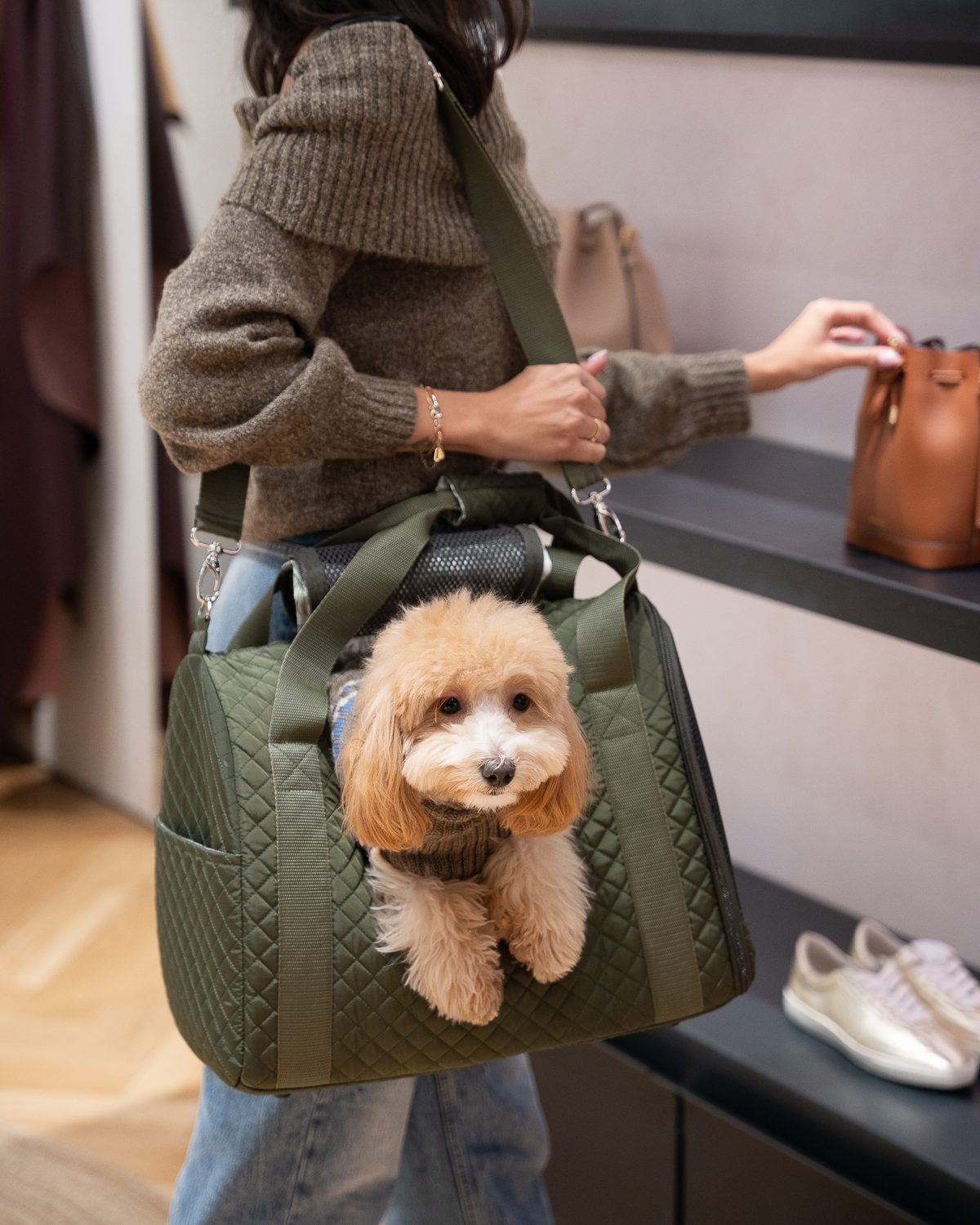
Closed bags — Gemma / Sophie / Samuel. This is the most recommended format for daily urban life with a small dog. More closed structure than the travel bag, with full closure and an extra level of containment. Gemma, Sophie and Samuel are the same model in different tones and finishes — the choice is aesthetic. For clients looking for a stable carrier to take the dog to work, the office or the neighbourhood café, especially if the dog is a bit nervous and needs to feel sheltered inside the bag.
Travel bags (weekends, getaways, long walks)
Travel bags — Hazel Marrón / Arthur / Mila. Designed for weekends, getaways and long walks of several hours. Handmade by Muffin & Berry, padded, with top opening with mesh, handles and adjustable shoulder strap, inner safety clip anchor and reinforced base. The three models are the same bag in different colours and finishes, so the choice is aesthetic: Hazel Marrón is the classic camel (the best-seller), Arthur and Mila are the other-coloured versions. Designed for toy and mini dogs up to about six kilos.
Camping Bag (with foldable side panels)
Camping Bag — available in Black and Grey. The name is misleading: it's not for actual camping or picnics, and it's not a standard shoulder bag (although it has a strap to carry on the shoulder). It's its own format, with a unique feature in the catalogue: the side panels fold out and give the dog more surface to lie extended. Ideal when your dog is the maximum size of a conventional bag and needs a little more room, or when you'll be out for many hours and want him very comfortable. We call it Camping because of the technical look of the fabric, but the function is urban bag with extra space.
Front backpacks (kangaroo style)
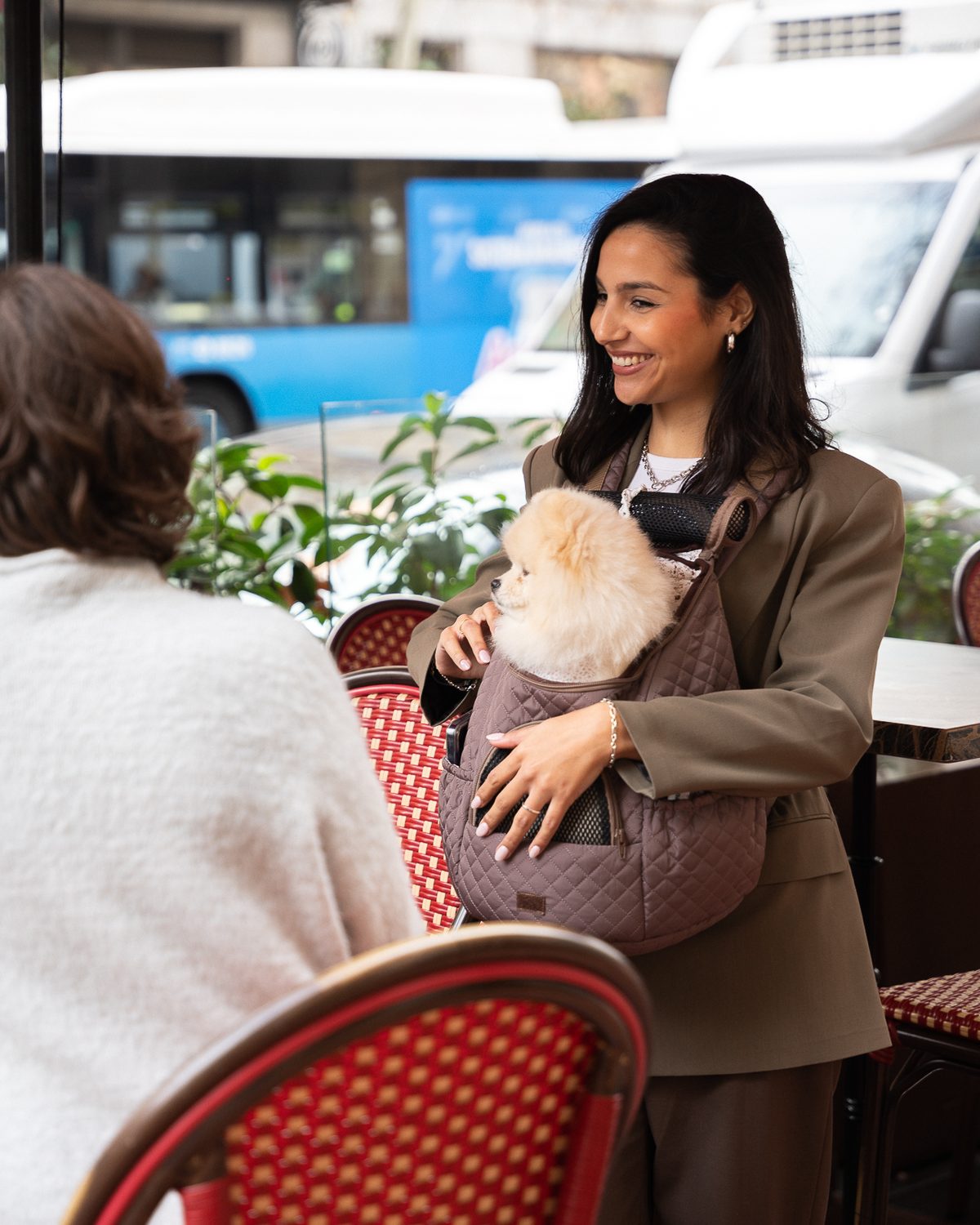
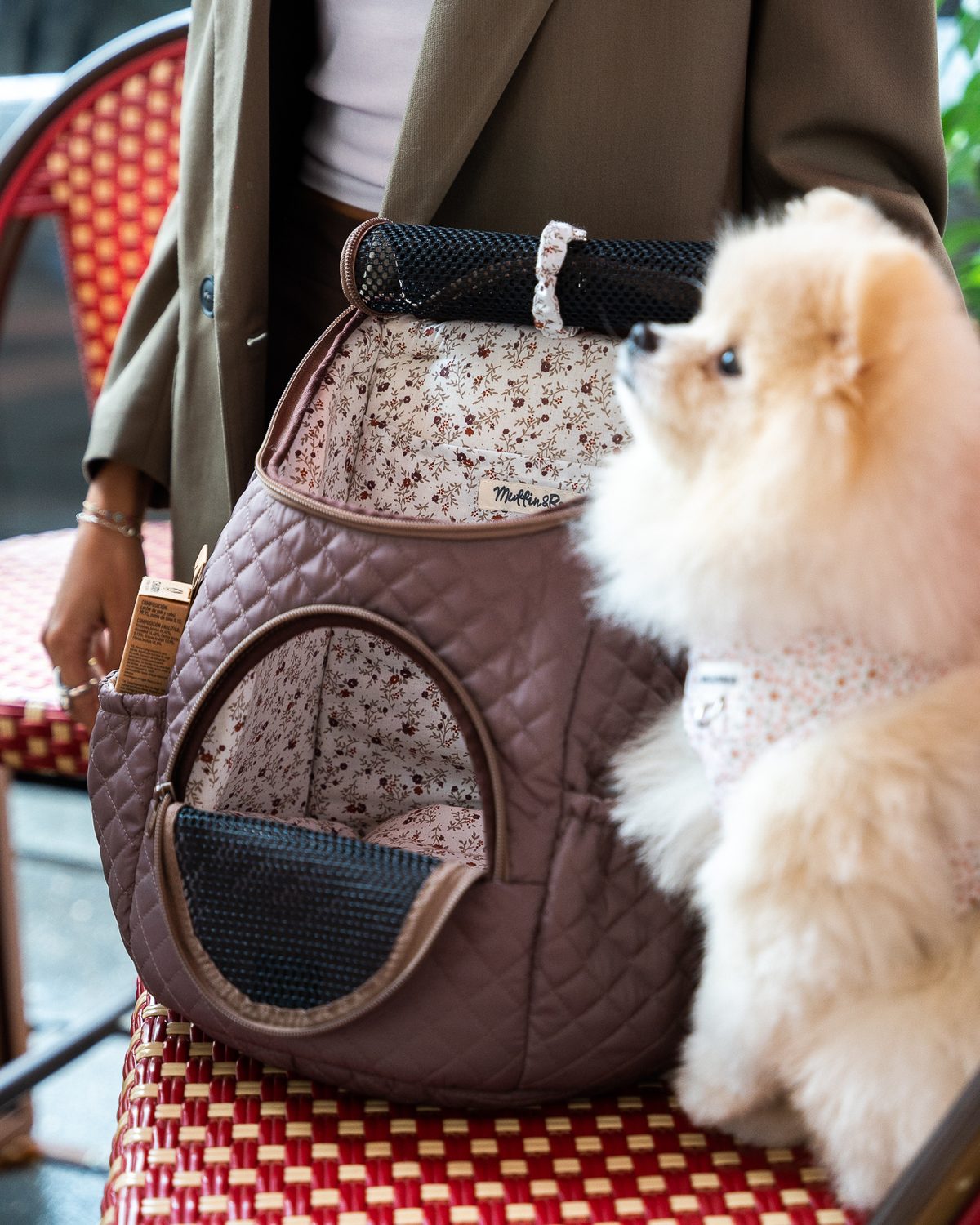
Hailey Backpack / Margaret Backpack. By Muffin & Berry, handmade in Lithuania. They are variants of the same product in different colours and prints — the choice is purely aesthetic. FRONT backpack, not back-worn — this matters: you wear it in front of your chest, kangaroo-style, with the dog facing forward. This way you see the dog at all times and the dog sees what's happening (unlike back backpacks, where the dog goes blind behind you, which are unsafe and we don't recommend). Light, padded, height-adjustable straps, full closure suitable for train or plane travel —always checking the carrier's measurements—.
Wheeled carriers (trolley)
Trolley Elegance and Large Black Trolley. A clarification first: trolleys are not pet strollers like a baby pushchair. They are wheeled carriers — the dog goes inside the lower compartment and you pull the trolley by the handle, like a suitcase. You don't push. Rigid structure also with hand handles for when you need to go up stairs. What are they used for in practice? AVE train travel with a medium dog —yes, many people use them with Renfe—. For planes, better to flag this from the start: very few airlines accept them in the cabin because of the measurements. If your plan is to fly with a medium dog, check the airline's measurements carefully before buying.
To see the whole catalogue, take a look at our dog bags section or our general dog travel articles. And if you have any doubts about size, write to us on WhatsApp with weight and measurements — we'll tell you which fits best.
In short: how to choose the right transport for your dog
If you've come this far with the doubt of what to buy, here's the practical summary:
- For daily urban use and small dogs (chihuahua, yorkie, bichon, toy poodle): shoulder or closed bag. Gemma, Sophie or Samuel are the ones I most recommend from the catalogue.
- For weekends, getaways or long walks of several hours: travel bag (Hazel Marrón, Arthur or Mila).
- For train or plane travel with a small dog, long-haul public transport or extensive urban walks: front backpack (Hailey or Margaret). Shoulder and travel bags are NOT accepted on planes or AVE trains.
- For older dogs, heavier dogs or AVE train travel with a medium dog: wheeled carrier (trolley). The dog goes inside and you pull by the handle, it's not a pushchair. For planes, careful: few airlines accept them in the cabin.
- If you're travelling by plane or train: there's NO universal approved bag. Check the carrier's website and buy thinking of the strictest one.
- Measure the dog before buying: body length, height at the withers, actual weight. Remember the dog goes LYING in the bag (not sitting). Compare with the bag's INTERIOR measurements, not exterior.
- If your dog is at the edge, bigger size. Slack is comfort — tightness is discomfort.
- Three things every good bag needs: mesh opening for ventilation, inner clip anchor for the dog's harness, and reinforced base.
If you have the scenario clear but are unsure about model or size, write to us on WhatsApp with weight, breed and measurements. And if you live in Madrid, drop by the shop — we'll try them on with your dog there, so you take home the bag that really fits.
About the author
Mar is the founder of Mascoboutique. What started as an idea to dress and equip her own dog became, over the years, a reference boutique in Madrid for families with dogs. Every bag, harness or accessory that comes into the shop passes through her hands first: she tests the materials, looks at the stitching and pictures the dog who's going to use it. That exigency is what she also applies to the blog: here we don't recommend what sells best, but what she'd put on her own dog.